Category: Cybsersecurity

  • Your email is the master key to your whole life – here’s how to lock it

    If I could get you to properly protect just one account and walk away, it would be your email. Not your bank, not your Facebook – it’s your email. It sounds dramatic, but once you see why, you’ll never think of your inbox as “just email” again.

    Why email is the master key

    Think about what happens when you forget a password – for your bank, your shopping accounts, your social media, almost anything. You click “forgot password,” and where does the reset link go? Your email.

    That means your inbox isn’t just a pile of messages. It’s the central key cabinet for your entire digital life. Anyone who controls your email doesn’t need to know your other passwords – they can simply reset them, one by one, letting themselves into your bank, your accounts and your photos using your own inbox as the master key. Worse, they can do it quietly, deleting the alerts as they go, so you don’t notice until the damage is done.

    So while it might feel like the least exciting account you own, it’s actually the most powerful. Lock this one properly and you’ve protected everything downstream of it. Here’s how, in two steps.

    Step 1: A strong, unique password, used nowhere else

    The two words that matter most here are unique and strong, and unique is the bigger one.

    Unique means this password is used for your email and nothing else. Here’s why it matters so much: companies get hacked all the time, and when they do, the passwords get leaked and sold. If you use the same password on your email as on some forum you joined a decade ago, a criminal who buys that old leak will try it on your email – and walk straight in. One reused password is all it takes. Your email password must be its own, used in exactly one place.

    Strong means long and hard to guess. Forget the old advice about cramming in symbols like P@ssw0rd! – length beats complexity. A short random string is hard for you and easy for a computer; a long phrase is the opposite. Three or four unrelated words strung together – something like copper-violin-harbour-maple — is both easy to remember and genuinely hard to crack.

    And if the thought of inventing and remembering a different long password for every account sounds impossible – you’re right, it is. That’s what a password manager is for: it creates and remembers them all, and you remember just one. It’s the single biggest upgrade most people can make, and it deserves its own post.

    Step 2: Two-step verification – the lock that saves you even if your password leaks

    Here’s the thing: even a great password can be stolen or leaked. So we add a second lock, and this is the one that genuinely stops most attacks dead.

    Two-step verification (you’ll also see it called two-factor authentication, 2FA, or two-step authentication) simply means that logging in needs two things: something you know (your password) and something you have (your phone). After you type your password, the service asks for a second proof – usually a short code from an app on your phone, or a tap to approve the login.

    The effect is enormous. Now, even if a criminal on the other side of the world has your password, it’s useless to them – because they don’t have your phone to complete the second step. You’ve turned a stolen password from a disaster into a non-event.

    Turning it on is easier than it sounds. In your email account’s settings, look for “Security,” then “two-step verification” or “2-factor authentication,” and follow the steps. If you can, use an authenticator app rather than text-message codes – it’s a bit more secure, but text-message codes are far, far better than nothing (I’ll expand on this in a different blog post). Whichever you choose, set it up once and it quietly protects you forever after.

    Fifteen minutes, and the most important door is locked

    That’s the whole job. Give your email a long, unique password, switch on two-step verification, and you’ve protected the one account that everything else depends on. It takes about fifteen minutes, you only do it once, and it moves you out of the “easy target” pile for good.

    If you do nothing else from this blog, do this. Everything else gets easier once the master key is safe.
  • The 5 things to protect first, in order

    When people finally decide to take their online safety seriously, they usually hit the same wall: there’s too much. Change all your passwords, turn on this, update that, watch out for the other thing. It’s overwhelming, so a lot of people do nothing at all.

    So let’s throw out the giant checklist. You don’t need to fix everything, and you certainly don’t need to fix it all today. You need to protect the few things that, if they fell, would take everything else down with them – in order. Here are the first five, from most important to least. Do them in sequence. If you only ever get through the first two, you’ll already be safer than most people you know.

    1. Your email

    Start here, always. Your main email account is the master key to your entire digital life, because it’s where every other service sends its “reset your password” link. If someone controls your email, they can take everything else one account at a time – so this is the single most valuable thing you own online.

    Give it a strong, unique password that you don’t use anywhere else, and turn on two-step verification (that’s the code-on-your-phone feature – more on it below). Lock this one door properly and you’ve protected the keys to all the others.

    2. Your banking and payments

    Next, the accounts with direct access to your money: online banking, and anything with your card saved and ready to spend, like PayPal, Amazon or your other go-to shopping sites.

    Use your bank’s official app rather than following links, turn on every alert they offer so you see any payment the moment it happens, and make sure two-step verification is switched on here too. The goal is simple: nobody moves your money without you knowing instantly.

    3. Your phone itself

    We protect accounts and forget the device sitting in our pocket – the one that’s already logged in to all of them. If your phone is easy to open, a lost or stolen phone hands someone your email, your bank and your messages in one go.

    So: a proper passcode (six digits, not 1234 or your birthday), fingerprint or face unlock switched on, and the screen set to lock quickly on its own. Make sure you can find and wipe it remotely if it goes missing. This is five minutes of setup that turns a lost phone from a disaster into an annoyance.

    4. Your most-used social and personal accounts

    Now the accounts that are your public identity – Facebook, Instagram, your messaging apps. These matter for two reasons: they hold years of personal information, and they’re the accounts scammers most want to hijack so they can impersonate you to everyone you know.

    Give each a unique password, turn on two-step verification, and take two minutes to check the privacy settings so you’re not quietly broadcasting your life to strangers. Losing one of these isn’t just your problem – it puts everyone in your contacts within reach.

    5. A backup of what you’d hate to lose

    The last one isn’t about keeping people out – it’s about making sure you never lose what matters even if something goes wrong. Photos, documents, the irreplaceable things.

    If everything you care about exists in exactly one place, you’re one broken phone, one theft or one bad click away from losing it forever. Make sure your important files are copied somewhere else – a cloud backup, an external drive, ideally both. Then a ransomware scam or a dropped laptop costs you money, not your memories.

    The one habit that ties it all together

    You’ll have noticed the same two things keep coming up: a strong, unique password and two-step verification. That’s not padding – those two habits do the overwhelming majority of the work across all five. If remembering different passwords feels impossible, that’s exactly what a password manager is for, and it’s worth its own post.

    Don’t try to do all five tonight. Do number one this week. Do number two next week. Work down the list at whatever pace you’ll actually keep. Protecting what matters isn’t a single heroic afternoon – it’s a handful of small locks, fitted one at a time, on the doors that count most.

  • How to spot a scam message in 10 seconds

    Most scams don’t get you because they’re clever. They get you because you’re busy. You’re halfway out the door, your phone buzzes, you glance down, and some part of your brain reacts before the rest of it catches up. That gap between the glance and the thought is the entire business model.

    The good news is that almost every scam message, whether it’s a text, an email, a Messenger or a QR code stuck on a parking meter, leans on the same three tricks. Once you know them, you can check any suspicious message in about ten seconds, without being a tech expert. Here they are.

    1. It’s in a hurry

    Scams run on urgency. Your parcel will be returned today. Your account will be suspended within 24 hours. Unusual login detected – act now. Final notice.

    There’s a reason for this. Panic switches off the careful part of your brain. If you feel a jolt of “oh no, I need to deal with this right now,” that feeling is not an accident – it was designed, and it’s the single most reliable sign that something is wrong.

    Real organisations like your bank, the post office or the tax office – they don’t operate on five-minute deadlines delivered by text. They can wait. They expect you to take your time. So the moment a message tries to rush you, slow down on purpose. The urgency itself is the tell.

    2. It wants you to tap a link

    Almost every scam needs you to go somewhere – a link to “confirm your details,” “pay a small fee,” “track your parcel,” or “reschedule delivery.” The link is where the actual theft happens: a fake page that looks just like the real one and quietly pockets whatever you type in.

    This is exactly how the fake parking-fine texts and the dodgy QR codes work – the message is just the doorway, and the link is the trap. So treat any link in an unexpected message as guilty until proven innocent.

    Two quick checks:

    • Don’t tap – go direct instead. If the message claims to be from your bank or a delivery company, open their official app or type their website address in yourself. If something genuinely needs your attention, it’ll be there too. If it’s only in the text, it’s a scam.
    • Look at who actually sent it. Scam links often live on web addresses that are almost-but-not-quite right, or are random strings of letters. A real company doesn’t ask you to log in via a link that looks like nonsense.

    3. It asks for something it shouldn’t

    The third tell is the ask. Scams want something a legitimate message would never request out of the blue: your password, a verification code sent to your phone, a card number, or a payment through an unusual channel like gift cards, crypto or a bank transfer to a stranger.

    Burn this one sentence into your memory: no real bank, company or government office will ever ask you for your password or a one-time code. Not by text, not by email, not on the phone. Anyone who does is, by definition, trying to rob you. A verification code is the key to your account — reading it out to someone is handing them the key.

    Same goes for the method of payment. If someone insists on being paid in gift cards or cryptocurrency, or needs you to move money “to keep it safe,” that’s not how any honest organisation works. It’s how scams work, because those payments can’t be undone.

    Your 10-second check

    Next time a message makes your stomach drop, run it past these three questions before you do anything:

    • Is it rushing me? Deadlines, threats, “act now” – that’s pressure, and pressure is a red flag.
    • Does it want me to tap a link? Don’t. Go to the app or website directly instead.
    • Is it asking for a password, a code, or an odd payment? Stop. No legitimate sender ever needs those.

    If you get even one “yes,” don’t reply, don’t tap, don’t phone the number in the message. Just set the phone down. Nothing bad happens from waiting. If you’re genuinely unsure whether a message about your bank or a parcel is real, contact the company the way you normally would – their app, their official number, their website – and ask. It takes a minute, and it’s the minute that keeps your money yours.

    Scammers are counting on speed. Slowing down is the whole defence – and now you know exactly what to look for while you do.

  • “I’ve got nothing worth stealing” – the most expensive myth online

    Every time I talk to someone about staying safe online, there’s a moment where they shrug and say some version of the same sentence: “Why would anyone bother with me? I’m not rich, I’m not famous, I’ve got nothing worth stealing.”

    I understand it completely because it feels true. When you hear the word hacker, you probably picture someone hunting for government secrets, or draining a billionaire’s bank account like in the movies. You are none of those things, so you relax.

    That picture is exactly why the myth is so expensive. It’s wrong about who gets targeted, wrong about what’s valuable, and wrong about how any of this actually works. Let’s walk through it, because once you see it clearly, you can’t unsee it and that’s a good thing.

    Nobody chose you. That’s the point.

    Here’s the part that surprises most people: the vast majority of online attacks aren’t personal. No one sat down, looked at your life, and decided you were a worthy target. The scams that reach you were sent to hundreds of thousands of people at once, by software, automatically, around the clock.

    Think of it less like a burglar casing your specific house and more like someone walking down the street at night pulling every car door handle. They don’t know you. They don’t care who you are. They’re just counting on the fact that, out of thousands of doors, plenty will be unlocked. You don’t have to be interesting to get caught – you just have to be reachable, and we are all reachable now.

    So “why would anyone bother with me” is the wrong question. Nobody is bothering with you specifically. They’re bothering with everyone, and hoping you’re one of the unlocked doors.

    What they actually want isn’t your money – it’s your access.

    The second half of the myth is that there’s nothing of value to take. But criminals aren’t only after cash in a bank account, that’s often the last thing they go for, because it’s the most defended. What they want first is access, and you have plenty of it.

    Your email account, for example, is worth far more than it looks. It’s the place every one of your other accounts sends its “reset your password” link. Get into your email, and a stranger can quietly walk into your online banking, your shopping accounts, your social media, your cloud photos, one at a time, using your own inbox to let themselves in.

    And even when there’s no money involved, there’s value:

    • A logged-in account they can use to send scams to other people (loved ones included)
    • Your saved card details on a shopping site
    • Years of photos and messages they can hold hostage
    • Your identity – enough personal details to open accounts or take out credit in your name
    • Simply your trust, and the trust everyone has in you

    None of that requires you to be wealthy or important. It just requires you to be a normal person living a normal digital life – which is to say, it requires you to be exactly who you are.

    This is the part people miss: you’re a door to everyone you know

    Here’s what makes “I’ve got nothing worth stealing” not just wrong, but unfair to the people around you.

    When someone gets into your account, they rarely stop at you. The real prize is your contact list. A message asking for money, or carrying a dodgy link, lands very differently when it comes from your name – your mum, your colleague, your best friend will click it, because they trust you. You became the bait without ever knowing it.

    Even if you genuinely believed you had nothing to lose, your account is still valuable – as a trusted way to reach everyone who loves you. Protecting yourself isn’t only about you. It’s about not being turned into a weapon pointed at the people you care about.

    What “something to protect” really means

    When I say you have something to protect, I’m not trying to frighten you. I’m asking you to look past the Hollywood hacker and see what’s actually on the line in an ordinary life:

    • Your money – not just savings, but the small, quiet thefts and subscriptions you’d never notice
    • Your identity and reputation – your name, used by someone who isn’t you
    • Your accounts – the keys to almost everything else
    • Your devices – the phone and laptop your whole life runs through
    • Your home – the cameras, routers and smart gadgets now connected to the internet
    • Your family – the people who trust you, and whoever you’re trying to keep safe

    Every one of those is something. Added together, they’re your whole digital life.

    The good news

    If the threat is automated and impersonal, then so is the defence. You don’t need to outsmart a genius who’s obsessed with you, because no one is. You just need to not be the unlocked door. A handful of simple habits move you from “easy” to “not worth the effort,” and the automated attacks move on to someone who hasn’t read this.

    That’s what this blog is for. Not fear, not jargon, not a lecture about how you’re doing everything wrong – just plain, practical steps to lock the doors that matter most.

    You do have something worth protecting. Let’s make sure it stays yours.

  • QR Codes: Ultimate Convenience or Cyber Threat?

    QR codes are everywhere now — restaurant tables, parking meters, posters, emails, even product packaging. They make life easier, but that same convenience has created a security blind spot most people don’t think twice about.

    What is a QR code?

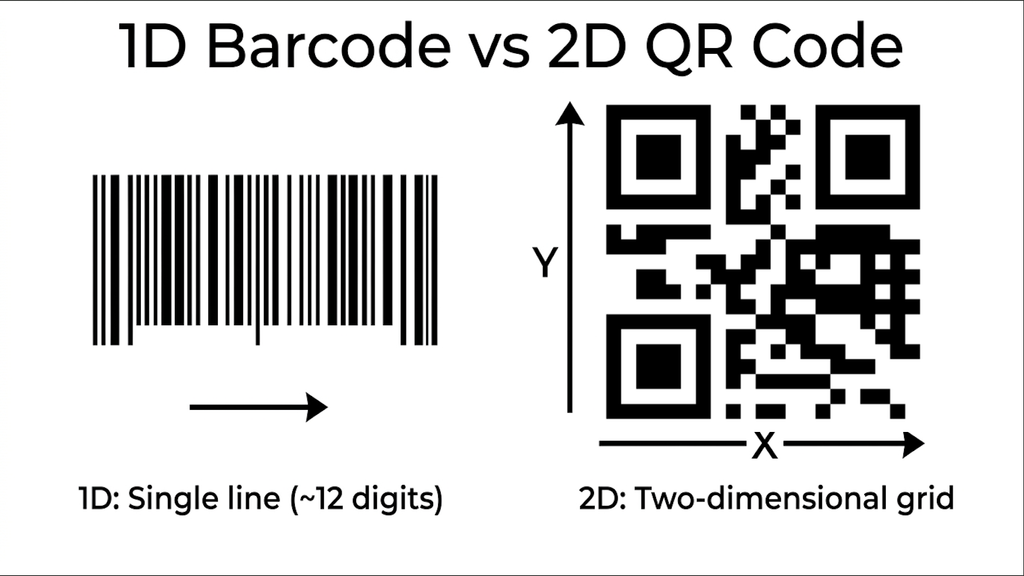
    A QR code is essentially a souped-up barcode. A standard 1D barcode stores data along a single line — usually a short string of numbers. A QR code stores data in a two-dimensional grid, which lets it hold thousands of characters instead of a dozen.

    barcode vs qr code
    QR code pointing to https://dainys.lt

    The most common use is encoding a web address: point your camera at the grid, and your phone decodes it and offers to open the link. That’s also exactly what makes QR codes useful to attackers — people trust the scan-and-go experience and rarely scrutinise what they’re about to open.

    Key risks to watch for

    Physical tampering (sticker overlays). Someone prints a malicious QR code on a sticker and places it directly over a legitimate one — on a parking kiosk, a flyer, or a restaurant table tent. Scanning it sends you to a cloned site built to capture login credentials or payment details, often while still showing the restaurant’s real logo and menu so nothing looks obviously wrong.

    Obscured destinations. Because the raw URL encoded in a QR code is often long, codes frequently point through a shortener or a redirect service. That’s normal — but it also means your phone’s preview may only show a shortened link (bit.ly/xyz123) instead of the actual destination. Attackers exploit this ambiguity deliberately, since a shortened link gives you nothing to visually verify before you tap it. (Legitimate businesses use dynamic QR codes too, for things like updating a menu URL without reprinting the code — the risk isn’t the dynamic link itself, it’s that you can’t tell a legitimate one from a malicious one just by looking.)

    “Quishing” via email and print. The same social-engineering tactics used in phishing emails now show up as QR codes embedded in emails, flyers, or fake delivery notices — bypassing email security tools that scan for malicious links in text, since the URL is hidden inside an image.

    How to protect yourself

    1. Check for physical tampering. Before scanning a QR code in public — parking meters are a favorite target — look and feel for a sticker that’s been placed over the original.
    2. Read the full URL before tapping. Most phone camera apps show a preview of the destination. Check that it matches the organisation you expect, not just that something loaded.
    3. Don’t enter sensitive info on a page you reached by scanning. If a QR code leads to a login or payment page, consider navigating to the organization’s site directly instead, especially for anything involving money.
    4. Keep 2FA enabled everywhere. If credentials do get phished, a second factor is often the difference between a close call and an actual account takeover.
    5. Treat QR codes in emails and texts like any other unsolicited link. If you weren’t expecting it, don’t scan it — verify through another channel first.

    Stay safe

  • The Parking Fine That Wasn’t: How a Single Text Almost Got Me

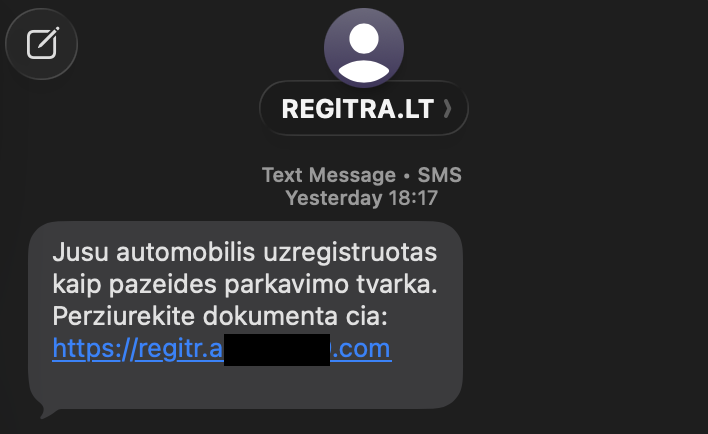
    Over the weekend I left my car in an unusual spot. A few hours later my phone buzzed with a text from “Regitra”:

    “Jūsų automobilis užregistruotas kaip pažeidęs parkavimo tvarką. Peržiūrėkite dokumentą čia: [link]”

    screenshot 2026 10 05 at 08.10.15

    (Your vehicle has been registered as violating parking rules. View the document here.)

    My heart rate jumped. For a second, I believed it. I had parked somewhere odd, so the message fit my situation perfectly.

    Then I looked at the link and remembered what Regitra actually does: vehicle registration and driver’s licences. Parking fines aren’t their job. They come from the police or municipal authorities. The domain was also a jumble of characters, nothing like an official address. I deleted the message and moved on.

    The timing was pure coincidence, but that’s exactly why it’s worth writing about.

    Why it almost worked

    Scammers don’t need to be clever. They need to land a message at a moment when you’re primed to believe it. This one used three levers:

    • Authority: a name you recognise and trust, in this case a state institution.
    • Context: a plausible reason to be contacted. Most of us drive, and most of us have parked badly at some point.
    • Urgency and fear: a fine implies a deadline, a penalty and a mistake you’ve made.

    When all three line up, your brain reacts before it analyses. The emotional jolt comes first, and the rational check (“wait, does Regitra even do this?”) comes second, if at all. Scammers are counting on you to tap before the second step.

    How these scams work behind the scenes

    This type of attack is called smishing, which is phishing by SMS.

    Here’s the typical chain:

    • Mass sending. Criminals send thousands or millions of texts to numbers they’ve bought, scraped or simply generated. They don’t know who owns a car or where it’s parked. Some people will always happen to match, and that’s all they need.
    • A lookalike link. The URL imitates a real institution with extra characters, a different domain ending, or random numbers. On a phone screen, where the address is truncated, it’s easy to miss.
    • A fake page. The link opens a convincing copy of an official site or payment portal. It may ask you to “confirm the fine”, log in with your bank or e-government credentials, or enter card details to pay a small amount.
    • Data harvesting. Whatever you type goes straight to the attacker. Some pages also ask for the one-time code your bank sends, which lets the criminal approve a transaction in real time while you think you’re paying a €15 fine.

    Some of these messages can even appear in the same thread as genuine messages from the real sender, because SMS sender names can be spoofed. A familiar sender name is not proof.

    What the consequences can be

    • A small “fine” can be the entry point to something much bigger:
    • Direct financial loss: drained bank accounts or unauthorised card payments, sometimes within minutes.
    • Identity theft: names, ID numbers, addresses and vehicle details are enough to open accounts or run further scams in your name.
    • Account takeover: if you reuse passwords, one stolen login can unlock your email, social media and online shopping.
    • Malware: some links install malicious apps or prompt you to grant permissions that give attackers access to your phone.
    • Follow-up attacks: once you’ve engaged, you may be flagged as a “responsive” target and hit with more convincing scams, such as a fake call from “your bank’s fraud department”.
      What to do instead

    Before you click:

    Ask whether this organisation actually handles this matter. Regitra deals with registration and licences, not parking enforcement.


    Never trust the link. Open the official website by typing the address yourself, or use the official app, and check for any real fine there.


    Look at the domain character by character. Extra numbers, odd spellings and unfamiliar endings are red flags.

    Be suspicious of any message that creates pressure to act immediately.

    If you’ve already clicked or entered details:

    1. Call your bank right away. Block your cards and ask them to review recent transactions. Speed matters most here.
    2. Change your passwords for any account you entered, and for any other account that uses the same password. Turn on multi-factor authentication.
    3. Check your phone. If you installed anything or granted permissions, remove the app and consider running a security scan.
    4. Report it. Tell the police and your national cybersecurity authority (in Lithuania, the National Cyber Security Centre). The real institution being impersonated often wants to know too, as it helps them warn others.
    5. Watch for follow-ups. Expect suspicious calls or messages in the following days and treat them with extra caution

    The takeaway

    I didn’t avoid this because I’m especially savvy. For a moment, my pulse went up like anyone’s would. What saved me was a habit: pause, then ask who actually handles this and where the link really goes.

    Scammers rely on speed. A five-second pause is one of the strongest defences you have, so build it into the way you read messages.